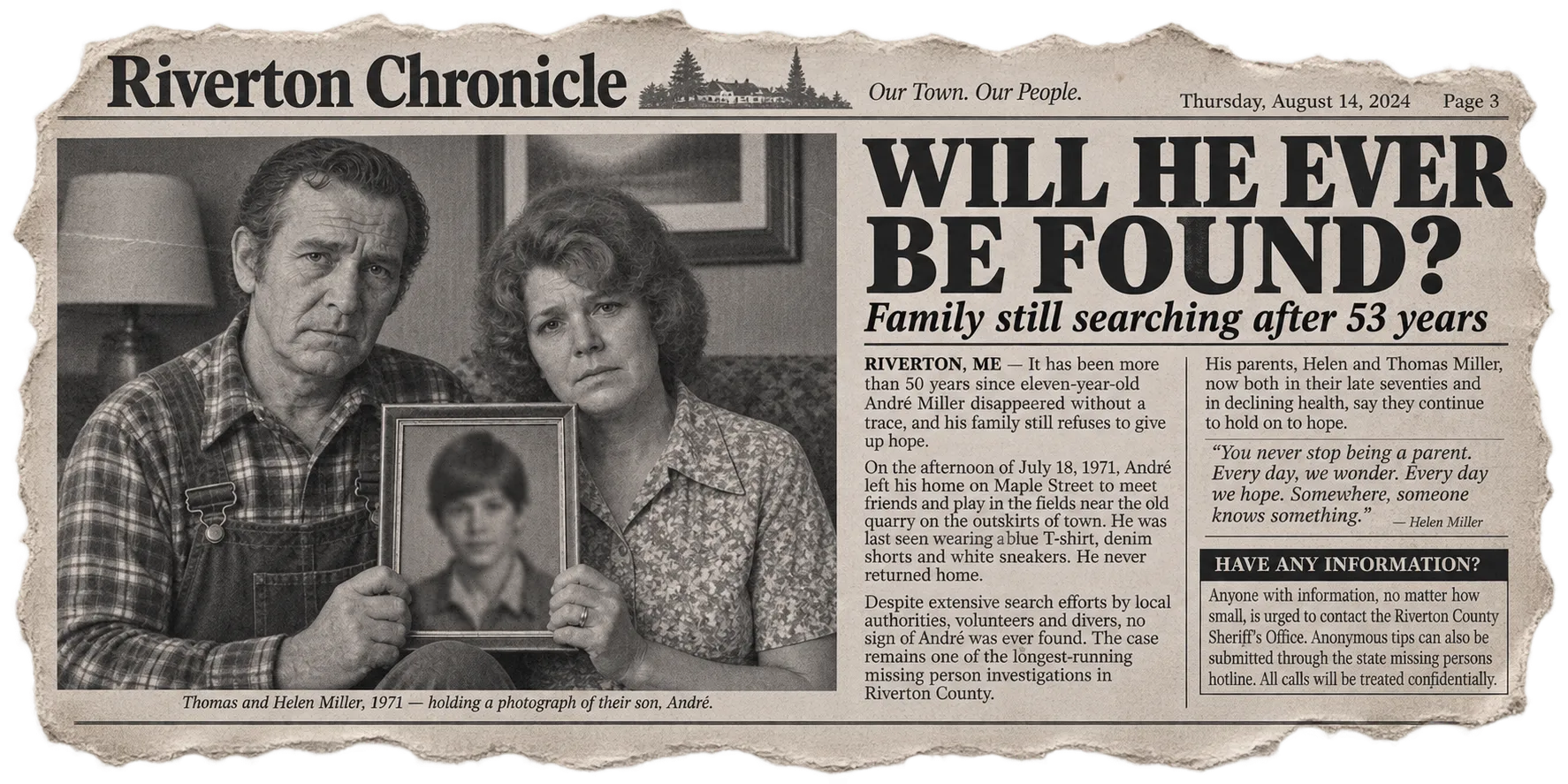
The other day I found myself reading the newspaper, which is something I still do even though almost nobody I know bothers anymore. I like the feel of it, I suppose. The ink on your fingers, the awkward size of the pages, the little ritual of folding it back on itself while drinking coffee.
There was an article on page seven that caught my attention. The photograph showed an elderly couple sitting side by side on a sofa. They were well into their seventies, perhaps older. The woman was holding a framed school photograph against her chest, and the man beside her looked tired in a way that had nothing to do with age. Above them, in thick black letters, was the headline: WILL HE EVER BE FOUND?
I read the article twice. Their son had disappeared during the summer holidays more than fifty years ago. Eleven years old. He had left the house one afternoon to play with friends and never came home. These things happen far too often. Children disappear. Parents spend the rest of their lives waiting for a telephone call that never comes. They grow old wondering whether their child grew old somewhere too, or whether he died frightened and alone. No grave. No goodbye. No peace.
I stared at the photograph for quite some time. Then I remembered my friend André.
Back when I was a kid, there were four of us. André, Ben, Oliver and me. We were always together. This was before mobile phones, before streaming services, before every child carried the entire world around in his pocket. If you wanted to find your friends, you got on your bicycle and went looking for them. You knocked on doors. You shouted names from the pavement. You knew where everyone’s parents worked and which gardens you were allowed to cut through.
We had whole days to waste, and we wasted them magnificently. We set fire to rubbish bins. We rode our bicycles through places bicycles had no business being. We climbed on roofs. We threw stones at things just to hear the noise they made when they broke.
Once, we stole a little caravan the circus people had left behind on an empty field. Stole might be too generous a word. We managed to move it perhaps fifty metres before Ben decided it would be much more interesting to tip it over. All four of us pushed until the thing finally went. I can still remember the sound. Wood splintering, glass breaking, cupboards bursting open, pots and pans rolling everywhere. It sounded wonderful. We ran until our lungs hurt.
Looking back, perhaps mobile phones would not have been such a terrible invention after all. Not everything we did was harmless, even if it seemed harmless at the time. Children have a remarkable talent for surviving things they do not yet understand.
André was the youngest. He was eleven, I think. Ben was thirteen, which made him a teenager, a fact he reminded us of at least six times a day. Oliver and I were twelve. Being thirteen apparently gave Ben certain privileges. He knew more about girls. He swore with greater authority. He claimed to understand cigarettes despite having smoked exactly half of one behind his father’s garage before vomiting into a hedge. But he was a teenager, and that settled most arguments.
It happened late in the summer, on one of those school holiday afternoons that seemed as though they might go on forever. The sun was high, the air smelled of dry grass, and none of our parents expected to see us again until dinner.
We went out to the fields. The cornfields were our favourite. You could disappear inside them completely. We made pathways by pushing the stalks aside and flattening sections of ground. We built enormous forts in there, or enormous to us anyway, with rooms and tunnels and secret entrances. Farmers hated us. We hated farmers. It was an uncomplicated relationship.
That afternoon, though, Ben decided he had grown beyond corn forts. “Teenagers don’t build forts in cornfields,” he said, and then he walked off. Oliver followed immediately. André followed Oliver, so I followed André. That was how things worked.
We crossed two fields and climbed through a gap in a hedge. Beyond it was a dirt track that led toward the old quarry. “I’m not going all the way to the quarry,” I said. Nobody answered. “My mum said I’m not allowed.”
Ben turned around and walked backwards for a few steps. “Your mum isn’t here.”
“She says it’s dangerous.”
“Everything’s dangerous.”
Then he turned away again.
A couple of years later, a boy drowned in that quarry. He slipped near the edge while throwing stones, according to the newspaper. I did not know him, but everyone knew about it. My mother had been right. Mothers often are. Unfortunately, they tend to be right about things only after you have ignored them.
We almost reached the quarry that afternoon. Almost.
Someone had put a tall wire fence around the property. It looked new. Metal posts, heavy wire. Ben stood in front of it, looking up. “Let’s climb over.”
Oliver was immediately in favour. André and I were not particularly good at climbing fences, but at that age there are things worse than breaking your neck. Being called scared, for example.
I remember André running toward it first. He was the youngest and always felt he had something to prove. Maybe he thought Ben would be impressed. Maybe he thought we would laugh if he hesitated. Funny, the things you remember. His shoes were dirty. His T-shirt was blue. There was a grass stain on one knee. I remember all of that.
None of us saw the sign. Or perhaps we saw it and did not bother reading it.
DANGER. High voltage.
We knew electric fences anyway. The farmers had them around the cow fields. We had touched those before. Once Ben convinced us all to piss against one. There are certain mistakes a boy makes only once, and we laughed about that one for months.
So even if we had read the sign, I doubt it would have stopped us. But this fence was not meant for cows.
André got there first. He jumped, caught the wire with both hands, and there was a sound like a gunshot.
For years afterwards, whenever somebody slammed a car door too hard, I heard that sound again. André flew backwards. Not fell. Flew. His body landed several feet away and rolled once before stopping.
For a few seconds nobody moved. Nobody spoke. Even the birds seemed to have stopped. Then Oliver said his name.
“André?”
Nothing.
Ben laughed once. A strange little laugh. “André, stop fucking around.”
André did not move.
We ran to him, and I wish we had not. There are things you see as a child that stay behind your eyes forever. His hand was black. So were his eyes. I do not mean bruised. I mean black. His mouth was slightly open, and there was smoke coming from his sleeve. I knew immediately that he was dead, although I had never seen a dead person before. Some things do not require experience.
“What are we going to do?” Oliver whispered.
Ben started pacing. “My parents are going to fucking kill me.”
Nobody answered him.
“My dad told me not to come here. He said if I ever came to the quarry he’d kill me.”
“André’s dead,” I said.
“I know he’s fucking dead!”
“You said your parents would kill you.”
“You know what I mean.”
Oliver was crying now. “We need to get someone.”
“No,” Ben said.
“We need the police.”
“No!”
“It was an accident,” I said. “We won’t go to prison for an accident.”
Ben looked at me. His face had gone very pale. “I’m a teenager.”
For some reason I almost laughed. “So?”
“They can put teenagers in prison.”
“Not for an accident, man.”
“Nothing we could’ve done,” Oliver said.
Ben pointed toward the fence. “Apart from reading the fucking sign. And apart from not being here in the first place.”
That was the part that mattered. Not the fence. Not André. Our parents. The quarry. The rules we had broken.
At twelve years old, consequences are strange things. You understand being grounded. You understand having your bicycle taken away. You understand your father shouting at you. Death is harder. Death belongs to grandparents and television programmes. Being grounded is real.
For a while we talked about carrying André home. Then we talked about getting an adult. Oliver suggested leaving him there and pretending we had never seen him. Then he said, “We could throw him in the quarry.”
I remember staring at him. “What?”
“If they find him here, they’ll know.”
“I’m not going anywhere near that fence again,” I said.
“We could go around.”
“No.”
The sun had started dropping, and home time was coming. That frightened us more than anything. Soon mothers would begin standing in doorways. Soon fathers would start asking questions. Soon somebody would wonder where André was.
Ben finally said, “We bury him.”
There was a line of trees about a hundred metres from the quarry. The ground beneath them was softer than the hard-packed earth near the track. We used sticks at first, then stones. Oliver found a broken piece of metal that worked better.
It took us a long time. Longer than you might think to dig a hole big enough for an eleven-year-old boy. None of us spoke much. André lay nearby while we worked, and every so often I looked over at him. I kept expecting him to sit up. He never did.
When the hole was deep enough, we dragged him into it. That was the worst part. Not the fence. Not his burned hand. The weight of him. André had always been small. Dead, he seemed impossibly heavy.
We covered him with dirt, then leaves, then branches. When we finished, Ben made us put our hands together like football players before a match.
“No one tells,” he said.
Oliver was still crying.
“No one.”
We swore.
Then we rode home separately.
My mother shouted at me because I was late for dinner. I remember sitting at the table while she put potatoes onto my plate. She asked where André was.
I said I had not seen him that day.
The lie came surprisingly easily.
Police searched the fields for weeks. They searched the quarry too. Divers went into the water. Dogs went through the woods. Men in uniforms walked the roads and knocked on doors.
They questioned us, of course. I told them André had gone home before us. Ben told them something similar. Oliver cried during his interview, but Oliver cried easily anyway, so nobody thought much of it.
Once, I watched two policemen walk within perhaps twenty metres of where we had buried him. I was standing with my father at the edge of the field. One of the policemen stopped for a moment and looked toward the trees. I could not breathe. Then the other one called to him and they walked on.
They never found anything.
Eventually the searches stopped. People moved on. People always do.
Ben’s family moved away two years later. I have not seen Oliver since I was nineteen. I do not know where either of them are now.
André’s parents stayed. Apparently they still live in the same house. The newspaper said they never changed their telephone number.
Just in case.
I kept our promise. For more than fifty years I never told a soul. Not my parents. Not my wife. Not even after Ben’s name stopped meaning anything to me. Not even after I began having children of my own.
I kept the oath.
Until yesterday.
Until I opened the newspaper and saw that old photograph. André’s mother holding his school picture against her chest. His father beside her. Both of them still waiting.
The article ended with a plea for anyone with information to come forward.
I folded the newspaper, made myself another coffee, and sat for a while looking out of the kitchen window.
I suppose I should feel guilty. Maybe once I did. But they are very old now. They have carried hope with them for more than fifty years. Hope that André ran away. Hope that somebody took him. Hope that he built another life somewhere. Hope that one day the telephone might ring.
It seems cruel to take that away from them now.
So I won’t.
I hope they never find their son.